LEADERS

International LEADERS Calling Market Crashes Years Ahead
Second to None, Anywhere...

'Warned 2000 tech slide; predicted 2008 meltdown in 2007. Forecasted 2020 global economic collapse in 2011, AND NOW- BY 2050 - THE MOTHER OF ALL CRASHES"

THE #FUTURE #OUTLOOKS - KEY AREAS OF #CONCERN AND #RISK

  Economic and Markets 2023 Outlook WARNING  What Worked for the Past Decades Will Not For The Next WHAT'S COMING - GLOBAL RECESSION? DE...

GLOBAL MARKETS


Live World Indices are powered by Investing.com

Champion, Lead, Inspire

Search This Blog

GREAT BARGAINS; FUN IDEAS

Sunday, 7 July 2019

INVESTORS BEWARE: #Vancouver's Unaffordable #RealEstate #Bubble Burst - Now, Is #Toronto Next?


" we need to upend our fundamental and flawed assumptions about how housing works. Because right now, we’re just building on top of them."


Over the past 20 years, Toronto and Vancouver – two of Canada’s three most populous cities – have built 400,000 homes between them. That’s an enviable number for any city in North America seeking to increase supply, a reliable tactic for relieving a housing crisis.

But for its efforts, Toronto and Vancouver continue to top international rankings of unaffordable cities. That highlights a cold reality: We cannot build our way out of this affordability crisis.

We’re not alone. In cities such as Cairo, Sydney and New York, real estate has become hyper-commodified. Housing is now seen as a matter of selling, not dwelling, as made plain by Wall Street’s growing interest in the business of housing. And as a result, people cannot afford shelter – even though a significant number of housing units in those very same cities remain wholly unoccupied.

Image result for toronto housing bubble charts

The fundamentals of Canada’s housing system are broken. And while there is a way forward that’s within reach, it will require us to reject many tightly held 21st-century assumptions about the housing economy.

Read More

Canada At Risk As 'First Cracks' Appear In Global Housing Bubbles: UBS

House prices are now falling in half of the cities that have the highest risk of a bubble burst, Swiss bank says.
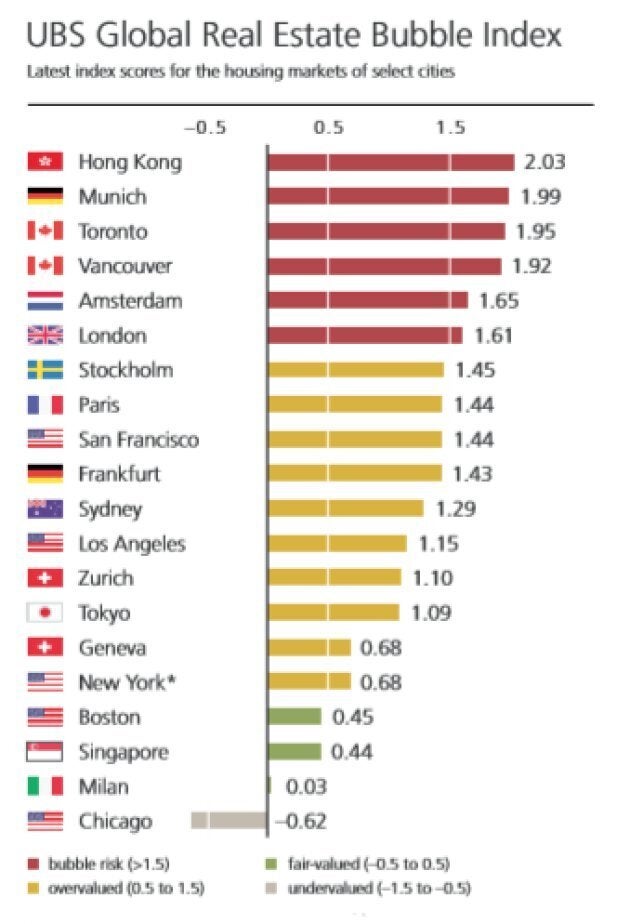


Canada At Risk As 'First Cracks' Appear In Global Housing Bubbles:


LEARN MORE

HOUSING BUBBLES - MASSIVE UNPRECEDENTED DEPRESSION LOOMS


Monday, 1 July 2019

#FED Should Hold Off #Rate Cuts


"While the proverbial Rubicon has been crossed with the Fed's latest rhetoric, it should carefully weigh the consequences of disappointing a financial market addicted to liquidity and losing its most valuable asset - its credibility"


THE latest statement by the Fed all but confirmed an upcoming rate cut in the months ahead. While the dovish U-turn made by Fed chairman Jerome Powell since December has definitely brought relief to the market, the fact is that the data-driven Fed of 2018 has been replaced by a market-driven Fed today. This is because the economic indicators are still relatively strong, but the drumbeat of preventing another market meltdown like the one in the final quarter of 2018 has grown louder.
The narrative goes like this: the Fed raised interest rates four times in 2018, the last one amid heightened trade tensions between the US and China, and this has caused the stock market to fall by more than 20 per cent. Some market indicators, especially the spread between the three-month interest rate and the 10-year Treasury note yield, have also gone negative - indicating that the market is expecting deflation in the future to compensate for lower long-term returns. Since the market represents the collective wisdom of all investors, their prognosis of the state of the economy must not be too far off.

BT_20190628_LBKINT_3820539.jpg

In the past, such a market prediction would have been corroborated by weak economic indicators. This time, however, economic indicators have remained strong.

LEARN MORE
ALTERNATIVE VIEWS SEE CUT COMING

Popular Posts All Time

Learn, win achieve