LEADERS

International LEADERS Calling Market Crashes Years Ahead
Second to None, Anywhere...

'Warned 2000 tech slide; predicted 2008 meltdown in 2007. Forecasted 2020 global economic collapse in 2011, AND NOW- BY 2050 - THE MOTHER OF ALL CRASHES"

THE #FUTURE #OUTLOOKS - KEY AREAS OF #CONCERN AND #RISK

  Economic and Markets 2023 Outlook WARNING  What Worked for the Past Decades Will Not For The Next WHAT'S COMING - GLOBAL RECESSION? DE...

GLOBAL MARKETS


Live World Indices are powered by Investing.com

Champion, Lead, Inspire

Search This Blog

GREAT BARGAINS; FUN IDEAS

Showing posts with label Puerto Rico. Show all posts

Friday, 31 July 2015

Nothing Can Stop Chinese Stock, Commodities, Currency Market Crashes, & More Top Insights


Emergency measures fail to halt China's stock market nosedive

July ends on another low note as stocks record biggest monthly loss in almost six years, despite concerted efforts by Beijing to prop up the exchanges

Image result for chinese panicsChinese share prices suffered a dismal end to a dire month as promises of more emergency measures from officials in Beijing failed to stem a stock market slide that is now reverberating around the global economy.
Despite policymakers’ pledges to underpin the flagging Chinese economy and a further crackdown by the markets watchdog, stocks fell further on Friday and posted their biggest monthly loss in almost six years.
Image result for chinese panics
The Shanghai composite index lost 10% this week alone and was down more than 14% for the whole of July. That extends the sharp sell-off that began in China’s stock market in mid-June, a rout that has prompted the country’s securities regulator to warn of “panic sentiment” gripping investors, many of whom are individuals that have borrowed heavily to play the stock market.


Home House For Sale Mortgage Mortgages

If The American Dream Is To Own A Home, Then It Hasn’t Been In Worse Shape Since 1967


Thanks to the “Obama recovery”, the rate of homeownership in the United States has fallen to the lowest level in 48 years.  The percentage of Americans that own a home is widely considered to be a key indicator of the health of the middle class, and we have just learned that during the second quarter of 2015 that number dropped from 63.7 percent to 63.4 percent.  It is now the lowest that it has been since 1967
Homeownership Rate 2015
 Unlike a lot of other government economic statistics, this one is fairly difficult to manipulate.  Either someone owns a home or they do not.  And what the homeownership rate is telling us is that the percentage of Americans that can qualify for a mortgage has been falling dramatically.  Just take a look at the following chart.  This is not just a decline – this is a complete and utter collapse…


Puerto Rico Risking Point of No Return With Debt Payment Default


Puerto Rico is poised to set in motion a chain of events to force investors into negotiating a restructuring of the island’s $72 billion debt burden.

The commonwealth’s Public Finance Corp. will likely fail to make $58 million in bond payments due Aug. 1, the first default since Puerto Rico was ceded to the U.S. following the Spanish-American War. Government officials say they can’t make the payment because the legislature didn’t appropriate the funds last month for the current fiscal year.
A default would be the biggest salvo yet between creditors and the debt-ridden island since Governor Alejandro Garcia Padilla said in June that Puerto Rico cannot repay its obligations and was seeking to delay debt payments for a number of years. Prices of the securities are tumbling as officials, who are pursuing the use of bankruptcy, prepare to release a debt-restructuring plan by Sept. 1.
“They’re setting up the process of the entire restructuring,” said Lyle Fitterer, who helps oversee $38 billion of municipal securities, including Puerto Rico debt, at Wells Capital Management in Menomonee Falls, Wisconsin. “They’re probably getting advice from someone saying if you’re not going to pay on som

Treasury Secretary says U.S. debt limit won't be hit before Oct. 30


The U.S. is not at risk of breaching the debt ceiling before Oct. 30, Treasury Secretary Jacob Lew said Wednesday, in a new estimate sent to Congressional leaders. Treasury has been using so-called extraordinary measures since mid-March. Lew told the lawmakers that those measures will now last through the end of October. The Treasury Secretary urged Congress to raise the debt limit as soon as possible. The debt limit caps how much the government can borrow. It used to be raised routinely but has recently become the source of a bitter political tug-of-war.

China Stocks Fall as Traders Puzzle Over Sudden Late-Day Swings


Chinese stocks fell suddenly in the last hour of trading, almost wiping out Wednesday’s rally and leaving investors in the dark about reasons for the moves.

The Shanghai Composite Index slumped 2.2 percent to 3,705.77 at the close, erasing an earlier gain of 1.5 percent. Drugmakers and technology companies led declines. A gauge of 100-day price-swings rose to the highest level in six years. Trading volumes in Shanghai have halved from their peaks in June, while margin debt, which had fueled a world-beating rally for China’s stocks, declined to a four-month low.
Thursday’s trading was almost a reverse image of the previous day, when the Shanghai Composite surged in the last hour to close 3.4 percent higher. Volatility has increased this week as Monday’s 8.5 percent plunge by the benchmark gauge shredded a calm induced by unprecedented state intervention.


viernes, 20 de septiembre de 2013
As for medical care, there’s always been free medical care in Argentina as well as private medical care. The public one was not very good but it kept you alive before 2001. After the collapse it just became pitiful and patients ended up in leaking, cold, roach-infested hospitals and were asked to bring their own gauze, cotton and bandages due to lack of supplies. The government is now using the private sector to compensate for the poor public one, making the private care much worse than it used to be.


Russian loan leafletsAccording to the Russian United Credit Bureau (UCB), 40 million Russians have loans or mortgages.
By June, 12.5m of those loans had not been paid for at least a month, and in another 8m cases the arrears stretched back over three months.


A rising number of Greeks in rural areas are swapping goods and services in cashless transactions since the government shut down banks on June 28 for three weeks, restricted cash withdrawals and banned transfers abroad to halt a run on deposits and prevent a collapse of the banks.


Learn Success: APPLY Tips From The Best


Jeff Bezos, Amazon– Jeff Bezos is a pioneer in world of internet commerce, and was instrumental in defining this space that is now defining many aspects of the internet world. It is Jeff Bezos who innovated the concept of “predictive analytics”–recommending products to customers based on search history and buying habits. Whether you like the concept or you hate it, the idea has made online commerce more profit rich and efficient, and is making online shopping a better experience for consumers throughout the world.


Top Weekly Ideas and Insights


An Inconvenient Truth:

What Happens When Science Confronts Unsubstantiated Fiction?


 EXISTENTIAL REALITY 


"Humanity Coming of Secular Age"

 - The Last Days of Theism -



Tuesday, 14 July 2015

Top Economist - China Worse Than '29 Crash, & Top Insights


China's stock market meltdown

Andrew Kenningham, a senior global economist at Capital Economics, discusses China's stock market crash.


China could be heading towards the biggest financial disaster since the 1929 Wall Street crash after shares on its stock markets nosedived, dropping by around 30 percent in less than a month.
More than $3.2 trillion has been wiped out in three weeks - an amount more than 10 times the size of the entire Greek economy.
The Chinese government has been scrambling to avert a crisis and has issued an emergency response to keep the flagging economy going.e

What Greece, Cyprus, and Puerto Rico Have in Common


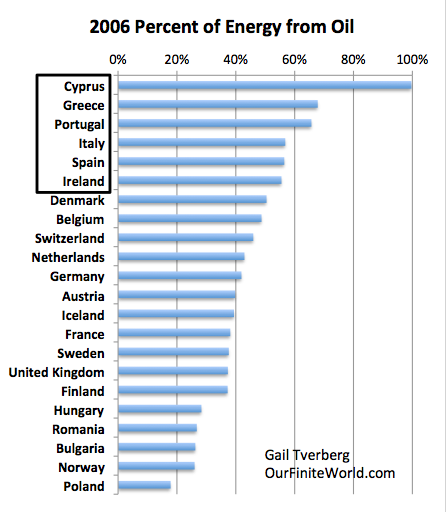
We all know one thing that Greece, Cyprus, and Puerto Rico have in common–severe financial problems. There is something else that they have in common–a high proportion of their energy use is from oil. Figure 1 shows the ratio of oil use to energy use for selected European countries in 2006.

Figure 1. Oil as a percentage of total energy consumption in 2006, based on June 2015 Energy Information data. (Inverted order from chart originally shown.)

Greece and Cyprus are at the bottom of this chart. The other “PIIGS” countries (Ireland, Spain, Italy, and Portugal) are immediately above Greece. Puerto Rico is not European so is not on Figure 1, but it if were shown on this chart, it would appear between Greece and Cyprus–its oil as a percentage of its energy consumption was 98.4% in 2006. The year 2006 was chosen because it was before the big crash of 2008. The percentages are bit lower now, but the relationship is very similar now.


In my last several crude oil updates, I showed that the “smart money” was betting against crude oil’s rebound that started in March, while the “dumb money” was the main driving force behind it. I have been skeptical of oil’s rebound due to persistently high inventories and the still-sizable long position held by speculators even after last year’s oil crash. Light sweet crude oil sank 7.6 percent during last week’s China-induced commodities rout and because active oil rigs rose for a second straight week after months of declines.
BrentCrude
West Texas Intermediate (WTI) crude oil broke down from its wedge patternthat I showed in late-June, and is now sitting just above its key $50 per barrel support level. If WTI crude breaks decisively below its $50 support level, a resumption of the 2014 oil bear market is quite possible. WTI crude may be forming a flag pattern that could indicate further declines if broken to the downside.

Oil Imports Have Energy Poor Greece In A Stranglehold


After several years, several months, several weeks and several days of crisis, it looks like things are about to come to a head for Greece and its banks. It becomes easier to understand exactly what GREXIT may mean for the Greek people. What happens when the banks and the government completely run out of money?
Greece has some indigenous coal production (lignite) but no oil or gas to speak of which means that all oil and gas are imported (Figure 1). This is linked to a structural trade deficit that contributes to the country’s dependency on debt. If Greece runs out of Euros, will it be able to buy oil and gas on the international markets? Greece held 90 days of oil stocks in 2010 [2]. Once that is gone then the tourist industry may collapse?

Carl Icahn Believes “There Really Is A Bubble Brewing”


Billionaire investor Carl Icahn spoke with FOX Business Network’s (FBN) Neil Cavuto and Trish Regan about the economy, saying “I believe that there really is a bubble brewing.” He went on to say that we are in “unchartered territory,” with historically low interest rates, and “a market that’s going up artificially,” which “could be very destructive to our markets and our economy.” When asked about what the Federal Reserve should do, Icahn said, “stop worrying what the markets will do,” and “start raising rates right now.” He went on to say that the “Fed is really pandering to a lot of these guys on Wall Street that they really shouldn’t be pandering to.” Regarding whether he’d take the role of Treasury Secretary, as Donald Trump suggested,” Icahn said, “I guess I would not. I sleep too late.”


The Greek Parliament is seen during a protest in Athens last night.
Two days of high-stakes negotiations between the finance ministers of the currency bloc resulted in a four-page document that included controversial German elements leaked on Saturday. Those measures included Greece leaving the euro temporarily by taking a “time-out” from the currency bloc if it refuses terms for talks on the new bailout or, in the event of agreement, that Greece sets aside €50bn worth of assets as collateral for new loans and for eventual privatisation. Both passages, however, did not enjoy a consensus among eurozone leaders.

4_jpgWhat is not an illusion is the extreme trouble many EU countries are in. Besides Greece, Spain and Italy are deep in debt. Smith contends, “Spain’s debt is a trillion euros. Italy is over a trillion euros in debt. We are talking fairly serious money here.”

China’s market is also shaped by the heavy hand of the government, which makes decisions about what companies can list shares, when to promote stock rallies and, now, how to intervene when prices plummet. The government, in other words, views the market as a policy instrument, a mechanism to fulfill its political and economic goals. The result can be a volatile market that swings from boom to bust.


More Leading Global Headlines


Popular Posts All Time

Learn, win achieve