LEADERS

International LEADERS Calling Market Crashes Years Ahead
Second to None, Anywhere...

'Warned 2000 tech slide; predicted 2008 meltdown in 2007. Forecasted 2020 global economic collapse in 2011, AND NOW- BY 2050 - THE MOTHER OF ALL CRASHES"

THE #FUTURE #OUTLOOKS - KEY AREAS OF #CONCERN AND #RISK

  Economic and Markets 2023 Outlook WARNING  What Worked for the Past Decades Will Not For The Next WHAT'S COMING - GLOBAL RECESSION? DE...

GLOBAL MARKETS


Live World Indices are powered by Investing.com

Champion, Lead, Inspire

Search This Blog

GREAT BARGAINS; FUN IDEAS

Showing posts with label creditcrisis. Show all posts

Thursday, 24 April 2014

ALERT -Japan's Bonds Risk Default; Sakakibara


Failure to up sales tax risks crash of JGBs: Sakakibara


The government should prioritize expanding its recent sales tax increase or risk an eventual collapse of sovereign bonds, former Finance Ministry official Eisuke Sakakibara said.


Eisuke Sakakibara | KYODO
A failure to raise the consumption levy “could trigger massive dumping” of the nation’s debt, Sakakibara said in an interview in Tokyo last week. “We must not derail from boosting the levy to 10 percent. The bond market’s collapse would be more dire than a tax increase.”
 
Prime Minister Shinzo Abe has indicated he will decide by the end of this year whether to go ahead with the sales tax increase to 10 percent in 2015, weighing the economic fallout of the 3-percentage-point gain to 8 percent this month. Gross domestic product may contract an annualized 3.3 percent in the second quarter, the sharpest drop since the first three months of 2011, according to a Bloomberg News poll of economists.
 
“Ten percent is still not enough” and Japan may have to eventually increase it toward 20 percent, in line with other developed nations, said Sakakibara, who is now a professor at Aoyama Gakuin University in Tokyo. “If we increase spending, we need to radically boost revenue.”
 
Economy minister Akira Amari said earlier this month the decision to hike the levy to 10 percent will not be easy. Sixty percent of respondents in a survey by Nikkei newspaper and TV Tokyo oppose the move, while 32 percent support it.
 
Domestic investors hold more than 90 percent of the government’s debt, which means the country is relying on the world’s fastest-aging population for financing. A quarter of Japanese will be over 65 years old by the end of 2014. That’s the highest ratio globally, according to U.S. census bureau figures compiled by Bloomberg.


Lets not forget; QE Japan style


Friday, 18 April 2014

China ALERT: Super Rich "KASH-lNG" Out

The Richest Man in Asia is Selling Everything in China


Here’s a guy you want to bet on– Li Ka-Shing.
LiKaShingLi is reportedly the richest person in Asia with a net worth well in excess of $30 billion, much of which he made being a shrewd property investor.

Li Ka-Shing was investing in mainland China back in the early 90s, way back before it became the trendy thing to do. Now, Li wants out of China. All of it.

Since August of last year, he’s dumped billions of dollars worth of his Chinese holdings. The latest is the $928 million sale of the Pacific Place shopping center in Beijing– this deal was inked just days ago. 

Once the deal concludes, Li will no longer have any major property investments in mainland China.

This isn’t a person who became wealthy by being flippant and scared. So what does he see that nobody

Read More


Getting to know you


Thursday, 17 April 2014

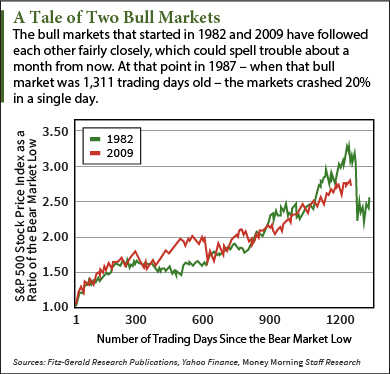
2014 Charts Mirror 1987 Black Monday

stock market crashBlack Monday Stock Market Crash Returns to Haunt 2014


Chart watchers have noticed an eerie pattern - the bull market of 1982, which ended in the Black Monday stock market crashof 1987, looks way too much like the current bull market.
The stock market crash on Black Monday - Oct. 19, 1987 - was the worst one-day fall in history. The Dow Jones Industrial Average plunged 508 points - a 22.6% drop, while the Standard & Poor's 500 index lost 58 points for a loss of 20.4%.
Such a loss today would slice over 3,200 points off the Dow and about 365 points from the S&P 500.
And while no one can predict the markets for certain, the chart lines for the two bull markets have given many market analysts pause.
"The bull market that started in March 2009 is now up 169% through Friday. That's nearly step for step with the rally that began in 1982," said Money Morning Chief Investment Strategist Keith Fitz-Gerald.
The reason people are getting worried now is that the Black Monday stock market crash happened 1,311 trading days after the start of that bull market. The current bull market will reach that milestone approximately one month from now.
But Fitz-Gerald isn't quite ready to hit the panic button.
Read More


Trip down Memory Lane


Tuesday, 15 April 2014

Does Evil Lurk In Greek Bonds?


Callaway: New 

Greek Bonds A Bad

 Sign

 David Callaway, USA Today


WASHINGTON D.C. — Forget tech stocks. Greek debt is the story of the week on Wall Street, proving once again that nobody can remember anything more than four years old.

Greece's finance ministry said nearly 90 per cent of the sale was to international investors. In the picture is headquarter of Greece's central bank in Athens. Photo:APLess than 50 months after Greece crashed out of global debt markets, having brought Europe and its single currency to the brink of destruction and shaken American investment portfolios to the core, the tiny sun-splashed nation was shamelessly back on the world stage Thursday. Greece raised more than $4 billion with a new bond sale, purchased almost entirely by investors outside the country and at a relatively low payback rate of 4.75%. Investors had pledged almost seven times that amount to try to get a piece of the offering, according to Bloomberg Newsciting a Greek government official.


The search for profit is difficult right now for investors. Interest rates in the U.S. and other major countries remain low following the global financial crisis of 2008 and early 2009. Stocks, especially in tech in the last year, have pushed new highs, at least until the last week. But the rush to buy Greek debt again is a clear sign of the absurdity of the bull market as it begins its sixth year.


Spring is for dreamers. Baseball season begins. In Chicago, Cubs fans are happy. In Silicon Valley, teenagers are fielding offers of billions of dollars for products they haven't built yet. Here in Washington, D.C., the cherry blossoms are blooming, Congress is getting along, kind of, and the International Monetary Fund is staging its spring meeting with a rosy prediction of global growth in the coming year.

Monday, 14 April 2014

Deep, Dark, Cold in China's Ghost Cities

This Chinese City’s Property Market Is Even Chillier Than Its -22-Degree Weather


Here in the frigid, wind-battered northeast Chinese port city of Yingkou, real-estate developer Zhang Wang is hoping that weather might be a selling point for potential apartment buyers.
Temperatures in the region plunge to -30 degrees Celsius (-22 Fahrenheit) in the winter. But in Yingkou, they bottom out at a mere -20 degrees, he says. Maybe he can get some buyers looking for a better climate.


Cities like Yingkou in China’s northeast rust belt were among the earliest cities in the country to be overbuilt. In 2005, now-Premier Li Keqiang was party secretary of Liaoning province, where Yingkou is located. He pushed a massive restructuring project to wean the region from its reliance on steel, coal and mining. 
As Mr. Li moved up the government ranks, developers counted on his endorsement as an implicit government backing of the region’s future development, developers and analysts say. Yingkou, along with other cities, sold vast tracts of lands to developers to build apartments for the workers who – they hoped –  would populate the new factories, malls and industrial parks to come.

Tuesday, 8 April 2014

ASIA HAMMERED - May Trigger Massive Global Sell-Off

The question we need to start asking ourselves is what could possibly prevent these markets from falling further?

TRADE SQUEEZE: High inputs = low outputs

 From a fundamental point of view, both Japan and China have been on our watchlist for months now for different reasons.  Japan because ts economy is shattered and has few prospects of becoming the economic tiger it once was, as dwindling global natural resources with higher prices, and increased foreign competition in export markets are impossible hurdles to overcome with mere clever technology. China,meanwhile is a massive credit bubble waiting to explode. The transparency, corruption, shadow banking  and other leveraged issues are set to make 2008 look like a tempestin a teapot. 


FUNNY MONEY - the shadow knows

 B y default, this takes down the  emerging markets in this region as well. Start to do the math - when the world's second and third largest economies are on the ropes - there is nothing to stop this from spreading  as the global economy begins to face the very real physical limits to growth .No inputs equals no outputs. Simple!

All would be wise to head for the high ground and avoid the experience of birthday-suit-swimming as the tide rolls out. The problem is that the abstractions of monetary and fiscal policy are ignored by physical laws and facts: there is thus, no where to run and nowhere to hide, as markets hold a correction in their cards that is long overdue. 


Remember no one ever rings a bell at the bottom...nor at the top, for that matter. Be Wise.


Investors' Insights

April 8,  2014 - 7:00 am 


(CNN) Asia shares extend losses after global sell-off; BOJ eyed


(CNN) Asian equity markets turned mixed on Tuesday as Chinese shares played catch-up with the region after a long weekend but sentiment remained shaky following a global stock sell-off overnight.
U.S. stocks declined for a third session, with all three major indices losing more than 1 percent as internet stocks like  Amazon.com,  Priceline Group,Google and Apple extended losses. Monday's losses pulled the S&P 500into the red for the year while the Nasdaq recorded its biggest three-session drop since November 2011.


NamePriceChange%Change
NIKKEINikkei 225 Index14631.66
-177.19-1.20%
HSIHang Seng Index22377.15
---
UNCH0%
ASX 200S&P/ASX 2005394.20
-19.52-0.36%
SHANGHAIShanghai Composite Index2058.83
---
UNCH0%
KOSPIKOSPI Index1985.21
-4.49-0.23%


Read More
More News


Popular Posts All Time

Learn, win achieve