Read More
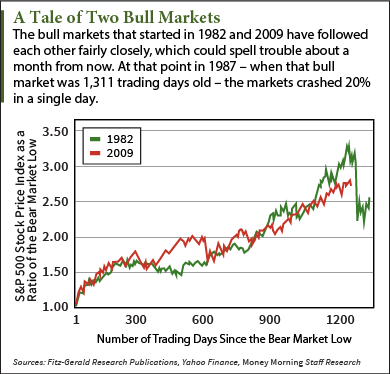
Do these markets smell like a sultry spring of 2000 or the crisp autumn air of 2008? Maybe we should go back to 1987? There is something in the air.
On the one hand, you have Faber calling "all-in" for a crash, while on the other; Miller says there is not much out there to bring prices down. Hmm. Markets are based on emotions not always rational. Market momentum is emotional energy conceptually pushing the mass of stocks to new levels. Who knows when that emotional energy will suddenly turn south? There is no realistic device to gauge that turn, so we are left with observing conditions that could possibly change the "emotional or conceptual energy" dramatically.
Let's start with the FBI's crackdown on the "Flashers" who have come to represent about 50% of volumes on both New York and London exchanges. All the new scrutiny could put a damper on their activities. That, in short, translates into a lowering of energy levels. Strike one.
Now let's not just talk about emotional energy, but what about "real energy" ? Here we should keep in mind that we hit peak oil back in about 2005, and sooner or later we are going to see rapid declines in global production. That means less real energy in the economy that lowers activity, GDP, earnings and thus valuations. We are probably past peak global oil production. Strike two.
Then there's that pesky concept of mean reversion sitting on the bench. When it comes to the plate then present value mathematics could clobber values by 50% or more as interest rates rise. The smart money has been shifting out of stocks for months now. That smells. Strike three.
International events do not portray a sense that the global economy is recovering, at all. The Ukraine, Cyprus, Greece, Spain and many other are still out there with the possibility of imploding without notice. Yet, those are small big concerns as the really big problems are China and Japan that are wobbling due to high leverage, falling business activity, shaky real estate and shrinking trade balances. Now we are not talking about hiccups like say Portugal, Ireland or Italy - no rather, they are the second and third largest global economies. Yikes, that's Strike four!
And why could they becoming unglued - well, go back to oil and real energy noted above, then we can start to see scarcities, including raw materials restricting the growth of these nations - that should also flow into emerging markets. Combine this with a highly inter-connected global banking system that has more aggregate credit leverage than in 2008 - oh my, only two words to come to mind ...Strike Five!
From the outfield, this brief suggests that the mathematics, energy, activity risks, emerging physical scarcities and credit leverage are all running in the wrong direction, along with the so-called smart money. There are way too many strikes, so Faber's call looks sound. Just one problem; however, ...
... he appears to be overly optimistic!
Investors' Insights
April 11, 2014
7:00 am, EST

 Black Monday Stock Market Crash Returns to Haunt 2014