

Investors' Insights Comments
After any significant corrections in the markets there is a high expectation of economic fall-out. China should not be immune to this pattern, human nature being what it is. But moreover, its slow down will affect the global stage - and who knows where that leads given the sheer fragility caused by excessive leverage.
So, as the Chinese proverbs reflect,all too often we are - "too soon old, too late wise."
So, as the Chinese proverbs reflect,all too often we are - "too soon old, too late wise."
Good Luck, Be Careful Out There
![China's stock markets have lost $3.4 trillion, an amount that is larger than the economy of most nations across the world [AFP]](http://www.aljazeera.com/mritems/imagecache/mbdxxlarge/mritems/Images/2015/7/14/0fed7ab0c9c64f0d89b10be207528c08_18.jpg)
China's great crash: Signs of trouble?
For years, leading experts have been warning about an impending structural downturn in China's economy, a prospect that looks highly likely as the Asian powerhouse runs out of export markets, cheap labour, and "ghost cities" to build.
 But few foresaw the dramatic crash in China's burgeoning stock markets, which arguably has foreshadowed other major international developments such as the Iranian nuclear negotiations as well as the Greek bailout drama.
In the span of a few weeks, China's stock markets have lost a staggering $3.4 trillion, an amount that is larger than the economy of most nations. The Shanghai index has lost 32 percent of its value since mid-June.
After relishing a meteoric rise in their shares earlier this year, many investors suddenly saw more than half of their entire wealth wiped out in China's casino-like stock markets.
As panic gripped investors in the country and beyond, the Chinese Communist Party enacted several draconian measures to stave off a complete free fall, leading to the suspension of half of the total trade in Shanghai and Shenzhen stock exchange markets.
Turmoil in China’s Stock Markets Takes a
Psychic Toll
(From The New York Times)
In some cities, students have dropped out of university, unable to give up their habit of tracking their investments, according to local news media. Wealthy investors have sought counseling, struggling to come to terms with the enormity of their losses after stock prices plunged. In response, doctors are advising traders to take up new hobbies and spend more time with family and friends. Some medical experts say high-risk groups, such as the elderly, the physically infirm and emotionally unstable, should consider withdrawing from the markets altogether.
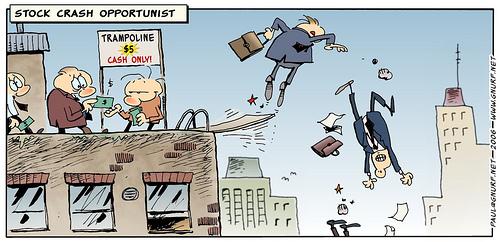
Marc Faber : The U.S. Stock Market could "easily" drop up to 40 percent
Why US stocks could drop up to 40%

The U.S. stock market could "easily" drop 20 percent to 40 percent, closely followed contrarian Marc Faber said Wednesday—citing a host of factors including the growing list of companies trading below their 200-day moving average. In recent days, "there were [also] more declining than advancing stocks, and the list of 12-month new lows was very high on Friday," the publisher of The Gloom, Boom & Doom Report told CNBC's "Squawk Box."

The world will be unable to fight the next global financial crash as central banks have used up their ammunition trying to tackle the last crises, the Bank of International Settlements has warned. The so-called central bank of central banks launched a scathing critique of global monetary policy in its annual report, claiming that central banks have backed themselves into a corner after repeatedly cutting interest rates to shore up their economies. These low rates have fuelled economic booms, encouraging excessive risk taking. Booms have then turned to busts, which policymakers have responded to with even lower rates.
 The enormously invasive measures Beijing used to stem trading losses may have damaged the Shanghai and Shenzhen exchanges for years to come.
 China is the number one threat to the global economy, analysts say, with an over-inflated "triple bubble" threatening to drag global gross domestic product below 2 per cent.
The bullion banks sell uncovered shorts on the gold futures market to drive down an otherwise rising price of gold. By dumping so many uncovered short contracts an artificial increase in “paper gold” is created, and this increase in supply drives down the price.
More Leading Headlines

Top Weekly Ideas and Insights
An Inconvenient Truth:
What Happens When The Fossil Energy Age Ends?
EXISTENTIAL REALITY
End Of Fossil Energy or Archaic Fabrications?


