LEADERS

International LEADERS Calling Market Crashes Years Ahead
Second to None, Anywhere...

'Warned 2000 tech slide; predicted 2008 meltdown in 2007. Forecasted 2020 global economic collapse in 2011, AND NOW- BY 2050 - THE MOTHER OF ALL CRASHES"

THE #FUTURE #OUTLOOKS - KEY AREAS OF #CONCERN AND #RISK

  Economic and Markets 2023 Outlook WARNING  What Worked for the Past Decades Will Not For The Next WHAT'S COMING - GLOBAL RECESSION? DE...

GLOBAL MARKETS


Live World Indices are powered by Investing.com

Champion, Lead, Inspire

Search This Blog

GREAT BARGAINS; FUN IDEAS

Showing posts with label Bear market. Show all posts

Thursday, 27 August 2015

Learn Easy Way To Lose $2.1 Trillion In Just Six Days! & More #Insights


$2.1 Trillion Erased From U.S. Stocks In Six Days


The enormous losses reflect the deep fears gripping markets about how the world economy will fare amid a deepening economic slowdown in China.

The DowS&P 500 and Nasdaq have all tumbled into correction territory, their first such 10% decline from a recent high since 2011.
The S&P 500 -- the best barometer for the biggest U.S. companies -- has lost trillions of market value in the six-day selloff through Tuesday, according to S&P Dow Jones Indices.
To put those losses into perspective, that's roughly equal to the combined market value of these corporate titans put together:
 Apple (AAPLTech30)Google(GOOGLTech30)Berkshire Hathaway (BRKA)ExxonMobil (XOM)Facebook (FBTech30)Walmart(WMT) and 21st Century Fox (FOXA).

South Africa's economy contracts, risk of recession grows


PRETORIA (Reuters) - South Africa's economy shrank for the first time in more than a year during the second quarter of 2015, raising the risk that labour disputes and slowing Chinese demand for commodities could push it towards recession.
The economic strain will inhibit the central bank from raising rates further to protect a weak currency and target inflation, while also torpedoing government efforts to keep deficits in check and protect its credit ratings.
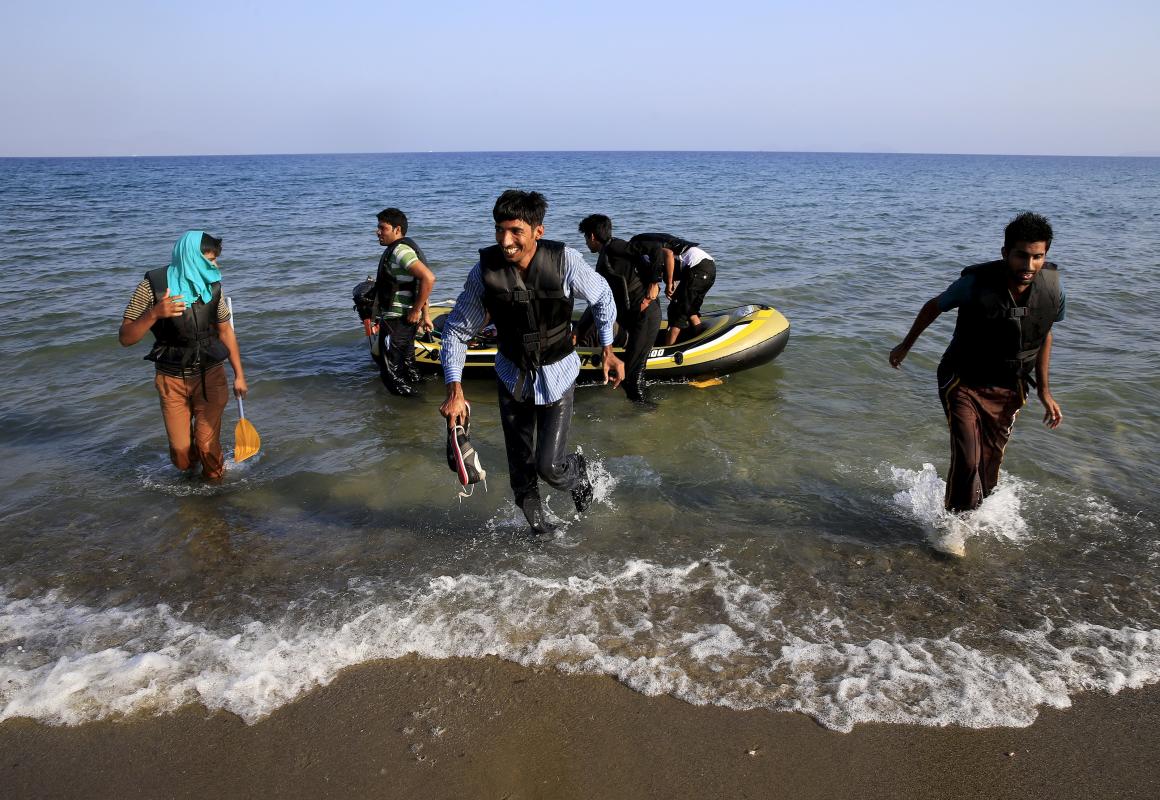


Afghan migrants arrive on the Greek island of Kos after crossing from Turkey to Greece

A record 107,500 migrants crossed the EU borders last month to outstrip the previous monthly record in June of 70,000. During the first seven months there were nearly 340,000 migrants, up from 123,500 last year,


Warring Migrant Tribes, Grenade Attacks…What Is Going On In Sweden?

A Police officer secures on December 16,
if you bring intolerant people into your country this is what can happen


Not only how we deal with the world and make sense of it, or interact with each other, but also how we look at ourselves and understand our own nature, existence, and responsibilities. 
This is the IT version of my book The Great Field (available in Kindle books).


Real Household Net Worth:


 Look Out Below?


In my last post I pointed out that over the last half century, every time the year-over-year change in Real Household Net Worth went negative (real household wealth decreased), a recession had either started, or was about to.  (One bare exception: a tiny decline in Q4 2011, which looks rather like turbulence following The Big Whatever.) Throughout, click for source. - 
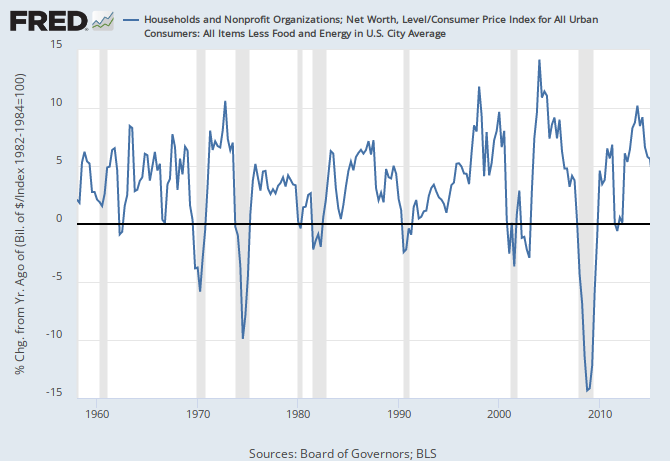


The problem: we don’t see this quarterly number until three+ months after the end of a quarter, when the Fed releases its Z.1 report for the the preceding quarter. The Q2 2015 report is due September 18.

But right now we might be able to roughly predict what we’re going to see four+ months from now, in the report on our current quarter, Q3, which ends September 30. We’re a bit over a month from the end the quarter, and we have some numbers to hand.


The U.S. equity markets are down roughly 7% year-over-year


Learning Success: 

APPLY Tips From The Best


Image result for sir richard bransonSir Richard BransonVirgin Group – Anyone who owns more than 400 companies and is worth billions of dollars is clearly doing many things right. I admire Richard Branson’s tenacity, and I admire his personal brand


Wednesday, 26 August 2015

Tale Of Black Monday In Amazing Charts, & More #Insights


A Seven Amazing Charts From Black Monday


The damage in the markets created by the decline since last Thursday, particularly on Monday, is significant. We have noticed 7 amazing facts on Monday August 24th, which will go into history books as another ‘Black Monday.’

The volatility index VIX registered a 6-year high, spiking ‘out of the blue’ to levels not seens since the great crash of 2008 / 2009. See the two red circles in the first chart.

VIX__24Aug_2015_600

The Dow Jones literally crashed in 3 trading days, a decline not seen in many, many years. The days of the October lows of last year were ugly, but that is nothing compared to the last 3 days. The Dow Jones lost more than 2,000 points in those 3 days, a loss of 11.4% from high to low.

Chinese banknotes

The heart of the matter is that Beijing has stepped on the gas in a quite complex long game; to liberalize the yuan exchange rate; allow it to free float against the US dollar; and establish the yuan as a global reserve currency.


Over the past 30 years, real per capita income has grown by more than 1,300%. Over the last decade alone, China quadrupled its industrial output. It now produces more automobiles than the US and Japan combined.


Discussion has shifted in recent years – from one concerning freedom, justice, democracy and rights into a political wrangle between antagonist camps. The people, who revolted across various Arab countries are now marginalized.


UN food agency describes conditions in war-torn nation as "perfect storm" as millions face massive food insecurity.13 million, adding that one in five of the country's population were suffering from severe food insecurity.


 Young Yemenis walk past a tank destroyed in clashes between Houthi and opposition forces in the southern port city of Aden, Yemen
Entrenched poverty, months of intensified warfare and limits on imports because of an international embargo have contributed to "catastrophic" conditions 


Why The Bear Of 2015 Is Different From The Bear Of 2008


Are there any conditions now that are actually better than those of 2008?
It's tempting to see similarities in last week's global stock market mini-crash and the monumental meltdown that almost took down the Global Financial System in 2008-2009. The dizzying drop invites comparison to the last Bear Market that took the S&P 500 from 1,565 in October 2007 to 667 on March 9, 2009.

But this Bear is beginning in circumstances quite different from 2007-08. 
Let's list a few of the differences:
1. Then: Markets and central banks feared inflation, as WTIC oil had hit $133 per barrel in the summer of 2008.
Now: As oil tests the $40/barrel level, markets and central banks fear deflation.
2. Then: China had a relatively modest $7 trillion in total debt, considerably less than 100% of GDP.
now: China's debt has quadrupled from $7 trillion in 2007 to $28 trillion as of mid-2014, an astonishing 282% of gross domestic product (GDP)
3. Then: Central banks had a full toolbox of unprecedented monetary surprises to unleash on the market: TARP, TARF, BARF (OK, that one is made up) rescue packages and credit guarantees, quantitative easing (QE), zero interest rate policy (ZIRP) and direct purchases of mortgages, to name just the top few.
Now: The central bank toolbox is empty: every tool has already been deployed on an unprecedented scale. Every potential new program is simply a retread of QE, yield curve bending, asset purchases, etc.--the same old bag of tricks.


Learning Success: 

APPLY Tips From The Best


Image result for sir richard bransonSir Richard BransonVirgin Group – Anyone who owns more than 400 companies and is worth billions of dollars is clearly doing many things right. We admire Richard Branson’s tenacity, and his personal brand

Friday, 7 August 2015

Emerging Markets In Free Fall, Oil Plunges, & More Top Insights


A selloff in emerging-market assets accelerated as currencies deepened their slump against the dollar amid mounting speculation that a U.S. interest-rate increase is imminent and energy stocks tumbled with oil prices.
Russia’s ruble fell for a second day as crude, the country’s biggest export, sank on concern a global supply glut will be prolonged. Brazilian bond yields rose to a record as President Dilma Rousseff suffered a setback in Congress that eroded measures to pare budgets and avoid a junk credit rating. The MSCI Emerging Markets Index traded at a more than two-year low as energy companies tumbled.

Developing-nation stocks, bonds and currencies have been dragged down by growing evidence that the U.S. economy is improving enough to embolden the Federal Reserve to raise borrowing costs for the first time since 2006 as soon as next month. The Fed’s near-zero interest rates have supported demand for riskier assets in emerging nations. Data on Thursday that showed filings for U.S. unemployment benefits near four-decade lows further bolstered the case for an increase.


Marc Faber – The Fed Has No Intention To Raise Rates


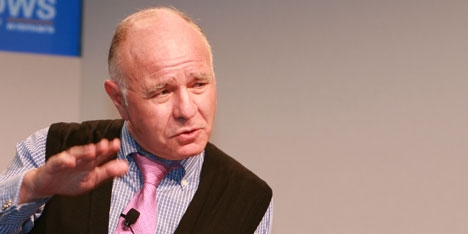
With the U.S. economic recovery being doubted by weaker economic data, and more and more market watchers expecting the Federal Reserve to make a move on rates at a later date, Kitco News speaks with Marc Faber, editor of the Gloom Boom & Doom Report, to find out what he has to say about it. “Given the dollar strength and that most recent economic statistics in the U.S. have been on the weak side, I don’t think the Fed has any intention whatsoever to increase rates,” he says, adding that if they do they will make sure that the increase would stay below the cost of living. “In other words, we would still have negative real interest rates,” he explains. Looking to gold, Faber says considering gold’s current price compared to the highs of 2011, he thinks this is a “reasonably good entry point.” Finally, Faber comments on Europe, which he says might outperform the U.S. economy this year. “Most of the European markets – I’m not saying all, I’d say Germany, France, Italy – they’re up something like 10% in dollar terms. I think 2015 will see a year where Europe outperforms the U.S. massively.” 


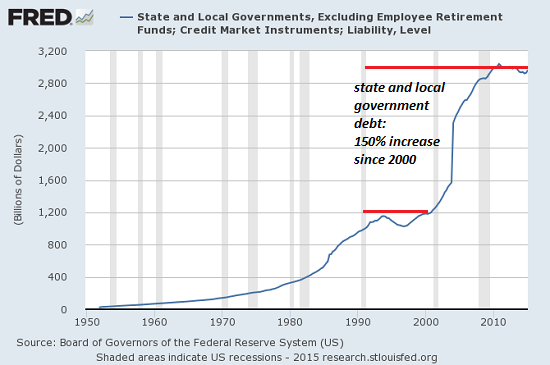
Here's the Next Crisis "Nobody Saw Coming"


When borrowing become prohibitive (or impossible) and raising taxes no longer generates more revenues, state and local governments will have to cut expenditures.


"Strangely enough, every easily foreseeable financial crisis is presented in the mainstream media as one that "nobody saw coming."

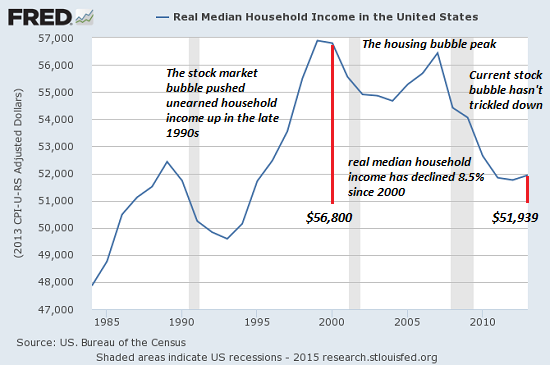
 No doubt the crisis visible in these three charts will also fall into the "nobody saw it coming" category.
Take a look at this chart of state and local government debt. As we noted yesterday, nominal GDP rose about 77% since 2000. So state and local debt rose at double the rate of GDP. That is the definition of an unsustainable trend


Earlier this year, as the market kept marching upward, I decided that buying put options on equities wouldn’t give me the kind of protection I was looking for. So I liquidated most of my equity holdings. We also shut down our equity strategy for the firm.
Of late, I’ve taken it a step further, starting to build an outright short position on the market. In the long-run, this may be losing proposition, but right now, I am rather concerned about traditional asset allocation.

Image result for abstract art jazz age


This money bubble is going to pop. It has to because there is just too much debt in the world. That debt has to be reconciled and, ultimately, when you are reconciling debt, it gets back to the point about collateral on the balance sheets. There is just not enough good collateral to support all of this paper money circulating out there


Image result for abstract art jazz age
The coverage of the TPP in the media was schizophrenic, on the one hand describing it as part of Obama’s “pivot to Asia” (as in an effort to contain China’s growing hegemony), meaning it was clearly a political enterprise, an “everybody but China” deal, and on the other hand, saying that the reason Americans should support it was those miniscule trade benefits. And of course, there was nary a mention of the cost in terms of national sovereignity.


“More people are finding jobs, but nobody feels optimistic about their income prospects,” he added. “That’s likely why it doesn’t feel like the economy has really recovered even though the statistics say it has.”


On a related matter—whether or not the nuclear agreement represents a bad deal for the people of Syria, who suffer under the Iran-supported Assad regime, which will presumably benefit financially from the lifting of sanctions on its primary sponsor—Kerry was somewhat dismissive. In response to my question, “Does it bother you that money will be going to Assad and Hezbollah?,” 

Kerry responded, “Yes, but it’s not dispositive. It’s not money that’s going to make a difference ultimately in what is happening.”


Canada Is On The Brink


 Of A‘Very Unusual


 Recession’


Canada is teetering on the edge of a recession.
The country's GDP has fallen for five straight months, the latest numbers coming in at a 0.2 percent contraction in May. And economists say Canada is about to hit its second-straight quarter of declining GDP, the technical definition of a recession.
Contributing to Canada's problems include plunging commodities prices, slowing exports and a falling Canadian dollar. The tumble in crude oil, which has fallen more than 15 percent year to date, has hit Canada hard as a commodities-heavy economy.
According to TD Bank's deputy chief economist, Derek Burleton, investor concerns about the Canadian economy date back to last year, when oil prices first began to fall.
"They're worried about Canada; they're still short Canada," Burleton said. "There's not a lot of upside to growth."


Learning Success: 

APPLY Tips From The Best


Warren Buffett, Berkshire Hathaway – He is a deeply conservative trader during the times that everyone around him is moving from one extreme to the other to the tune of huge losses and gains. Warren Buffett is a perfect example of patience, proving that slow and steady generally wins the business race. (Although I continue to press my own desire to spur Fishbowl’s inventory software business to race!)


Top Weekly Ideas and Insights

An Inconvenient Truth:


What Happens When Top Economists Realize Physical Growth Constraints?


 EXISTENTIAL REALITY 


"Humanity's Coming of Age"

 - The Last Days of Economic Growth -


Popular Posts All Time

Learn, win achieve