LEADERS

International LEADERS Calling Market Crashes Years Ahead
Second to None, Anywhere...

'Warned 2000 tech slide; predicted 2008 meltdown in 2007. Forecasted 2020 global economic collapse in 2011, AND NOW- BY 2050 - THE MOTHER OF ALL CRASHES"

THE #FUTURE #OUTLOOKS - KEY AREAS OF #CONCERN AND #RISK

  Economic and Markets 2023 Outlook WARNING  What Worked for the Past Decades Will Not For The Next WHAT'S COMING - GLOBAL RECESSION? DE...

GLOBAL MARKETS


Live World Indices are powered by Investing.com

Champion, Lead, Inspire

Search This Blog

GREAT BARGAINS; FUN IDEAS

Showing posts with label UK Pensions. Show all posts

Friday, 28 August 2015

China Piles Up Staggering $5 Trillion In Losses & More #Insights

Take the combined size of all stocks traded in Brazil, Russia, India and South Africa, multiply by two, and you'll get a sense of how much China's market value has slumped since the meltdown started. Shanghai-listed equities erased $5 trillion since reaching a seven-year high in June, half their value, as margin traders closed out bullish bets and concern deepened that valuations were unjustified by the weak economic outlook. 

The four other countries in the BRICS universe have a combined market capitalisation of $2.8 trillion, according to data compiled by Bloomberg. 


In the year to July, China's customs agency reports that imports from Australia are down by $15bn dollars on the same period last year - a loss which is already equal to 1% of Australia's GDP, and many other countries stand to lose out to similar degrees. China's imports overall are down by 14.6% over 2015. Find out what happens if this decline continues for the rest of the year - or worsens - and how that loss compares to each country's GDP


Eventually, even at near zero interest rates, the amount of debt becomes too high, relative to income. Governments become afraid of adding more debt. Young people find student loans so burdensome that they put off buying homes and cars. The economic “pump” that used to result from rising wages and rising debt slows, slowing the growth of the world economy. With slow economic growth comes low demand for commodities that are used to make homes, cars, factories, and other goods. This slow economic growth is what brings the persistent trend toward low commodity prices experienced in recent years.

A strange thing happened fifteen minutes after stock markets opened for regular trading on Friday, August 21, 2015. At least some people on the nationally prominent MarketWatch website were privileged to see in advance what would prove to be the full-day losses for both the Dow Jones Industrial Average (INDU) and the Standard & Poors 500 (SPX) indices. This harbinger or revelation of what was to come occurred six hours and fifteen minutes before the market's close. The uncanny trend projections, or perhaps target prices, were made available while the Dow was down about 180 points -- more than 350 points above its astonishing Friday close.

There is an almost touching faith that markets are rigged when they loft higher, but unrigged when they crash. Who's to say this crash isn't rigged? A few things about this "crash" (11% decline from all time highs now qualifies as a "crash") don't pass the sniff test.


"Unless we recognise that, and recognise that the productivity challenge and the fiscal challenge are intimately linked, and we have to deal with both of them, then we will go on continuing to repeat the mistakes that we've been making and that will get us into a situation that none of us want to be in."
Dr Parkinson earlier told a room of more than 90 corporate, community and academic leaders that productivity reform could not be detached from fiscal reform.


The ‘Black Monday' stock market turmoil on 24 August saw the FTSE 100 index plummet 14% below its peak of almost 7,000 points in February.

Investors across the globe began panic selling stocks, particularly in commodities, amid fears of the much anticipated growth slowdown in China.
While about £96bn was wiped off share values in the UK blue chip index, the Dow fell 1,000 points on opening and the Shanghai Composite experienced total losses of 35% since June.


Hymans Robertson put the total pain for UK defined benefit (DB) schemes at a staggering £30bn surge in aggregate deficits in a day, as equities values and bond yields headed south. 


Commentators are divided on whether the event was merely a market correction or an indication of more chaos to come.

But what many agree on is the fact that China is no longer the world's economic growth engine, posing the question of where future investment returns will come from.


Learning Success: 


APPLY Tips From The Best


Image result for sir richard bransonSir Richard BransonVirgin Group – Anyone who owns more than 400 companies and is worth billions of dollars is clearly doing many things right. I admire Richard Branson’s tenacity, and I admire his personal brand


Wednesday, 19 August 2015

Greenspan Warns Exuberant " Bond Bubble To Bust" & More Top Insights


Greenspan warns about bond-market bubble


: Former Federal Reserve Chairman Alan Greenspan is sounding the alarm about a bubble that he believes is forming in the bond market.
In two television interviews in recent days, Greenspan said interest rates could shoot higher and derail the economy when the bubble bursts.
The former Fed chairman says the current situation in the bond market is comparable to what happens in the stock market during an equity bubble.
Noting that stock-market bubbles are typically characterized by extreme price-to-earnings ratios, Greenspan said extremely low yields are telling a similar tale for bonds.
“If you turn the bond market around and you look at the price of bonds relative to the interest received by those bonds, that looks very much like the usual spread which would concern us if it were equities, and we should be concerned,” Greenspan said in an interview with Fox Business Network.


There are China analysts, and then there is Charlene Chu.
She has been called a rock star of Chinese-debt analysis. Money managers the world over pay tens of thousands of dollars for access to her research at her new firm Autonomous Research. Her reports are rarely leaked, and she rarely gives interviews.

Business Insider got a glimpse at a massive report she wrote at the end of July.

This was when everyone was freaking out about the precipitous fall of China's stock markets, and it predates the Chinese authorities' decision to devalue the yuan.

Her base case in the report was for Chinese authorities to maintain stability of the equity market and forestall contagion.There is also a doomsday scenario, however, in which there is contagion to other domestic and international markets, large capital outflows, and an acceleration of problems associated with financial-sector weakness and corporate indebtedness.

The report said: "This in turn would likely lead to a significant pullback in credit, putting the brakes on GDP growth and bringing an end to China's decades of stellar economic growth. At that point, social and political stability — the critical wild cards in this equation — could come under question."

This is what doom looks like


Growth in OPEC’s biggest exporter will slow to 2.8 percent this year and 2.4 percent in 2016 after oil prices slumped, the Washington-based IMF said in a statement on Monday. If spending isn’t curbed, its fiscal deficit would be “very large” this year and over the medium term, it added.


“Moody’s isn’t the only one predicting that growth will be slow to rebound,” said Ari Santos, a trader at Sao Paulo-based brokerage H.Commcor. “Looking forward, we’ll have a stagnant economy, with no growth and no outlook to grow.”


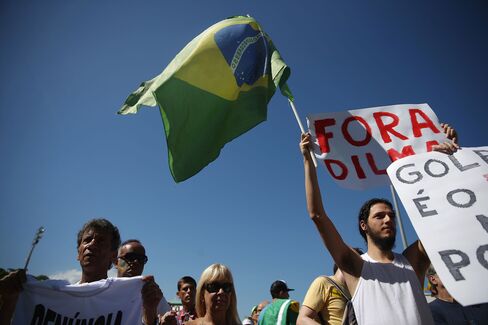
Protesters calling for the impeachment of President Dilma Rousseff march along Copacabana beach on Aug. 16, 2015.
In the midst of its deepest economic and political crisis in a generation, Brazil is contending with a business climate so punishing that major projects across numerous sectors are being frozen or shrunk, while small businesses slash prices and shift focus.


Singapore-based wealth managers, already under pressure from a global move towards tax information sharing, face a more immediate threat as Asian countries including Indonesia and India look to chase undeclared money in the low-tax city state. A global crackdown on tax evasion launched during the 2008 financial crisis has already forced Switzerland and other European offshore hubs to surrender their prized bank secrecy.


The combined deficit of private sector DB schemes in the UK

 now stands at around £900 billion, up from £250 billion

 since the start of the millennium, despite companies pouring

 in £500 billion towards pension saving over that time.

 According to Hymans Robertson, the stark figures highlight

 that for too long pension schemes have been taking too 

much risks


Learning Success: 


APPLY Tips From The Best


Larry Page,  Google – 


Image result for larry pageLarry Page is another example of a businessperson who can persevere any challenge. Larry and his company have faced much criticism and received ample praise over the years for his company’s actions. But in the midst of the storm, he has never let what others think sway him from pursuing the course for his company that he considers the best.


Top Weekly Ideas and Insights


An Inconvenient Truth


"Battle For Oil" 


What Happens When Political Interests Get Desperate?


EXISTENTIAL REALITY 


"Coming To The End Of Oil Age"


 - Looking Beyond The Brink -


Popular Posts All Time

Learn, win achieve