LEADERS

International LEADERS Calling Market Crashes Years Ahead
Second to None, Anywhere...

'Warned 2000 tech slide; predicted 2008 meltdown in 2007. Forecasted 2020 global economic collapse in 2011, AND NOW- BY 2050 - THE MOTHER OF ALL CRASHES"

THE #FUTURE #OUTLOOKS - KEY AREAS OF #CONCERN AND #RISK

  Economic and Markets 2023 Outlook WARNING  What Worked for the Past Decades Will Not For The Next WHAT'S COMING - GLOBAL RECESSION? DE...

GLOBAL MARKETS


Live World Indices are powered by Investing.com

Champion, Lead, Inspire

Search This Blog

GREAT BARGAINS; FUN IDEAS

Showing posts with label deflation. Show all posts

Friday, 28 August 2015

China Piles Up Staggering $5 Trillion In Losses & More #Insights

Take the combined size of all stocks traded in Brazil, Russia, India and South Africa, multiply by two, and you'll get a sense of how much China's market value has slumped since the meltdown started. Shanghai-listed equities erased $5 trillion since reaching a seven-year high in June, half their value, as margin traders closed out bullish bets and concern deepened that valuations were unjustified by the weak economic outlook. 

The four other countries in the BRICS universe have a combined market capitalisation of $2.8 trillion, according to data compiled by Bloomberg. 


In the year to July, China's customs agency reports that imports from Australia are down by $15bn dollars on the same period last year - a loss which is already equal to 1% of Australia's GDP, and many other countries stand to lose out to similar degrees. China's imports overall are down by 14.6% over 2015. Find out what happens if this decline continues for the rest of the year - or worsens - and how that loss compares to each country's GDP


Eventually, even at near zero interest rates, the amount of debt becomes too high, relative to income. Governments become afraid of adding more debt. Young people find student loans so burdensome that they put off buying homes and cars. The economic “pump” that used to result from rising wages and rising debt slows, slowing the growth of the world economy. With slow economic growth comes low demand for commodities that are used to make homes, cars, factories, and other goods. This slow economic growth is what brings the persistent trend toward low commodity prices experienced in recent years.

A strange thing happened fifteen minutes after stock markets opened for regular trading on Friday, August 21, 2015. At least some people on the nationally prominent MarketWatch website were privileged to see in advance what would prove to be the full-day losses for both the Dow Jones Industrial Average (INDU) and the Standard & Poors 500 (SPX) indices. This harbinger or revelation of what was to come occurred six hours and fifteen minutes before the market's close. The uncanny trend projections, or perhaps target prices, were made available while the Dow was down about 180 points -- more than 350 points above its astonishing Friday close.

There is an almost touching faith that markets are rigged when they loft higher, but unrigged when they crash. Who's to say this crash isn't rigged? A few things about this "crash" (11% decline from all time highs now qualifies as a "crash") don't pass the sniff test.


"Unless we recognise that, and recognise that the productivity challenge and the fiscal challenge are intimately linked, and we have to deal with both of them, then we will go on continuing to repeat the mistakes that we've been making and that will get us into a situation that none of us want to be in."
Dr Parkinson earlier told a room of more than 90 corporate, community and academic leaders that productivity reform could not be detached from fiscal reform.


The ‘Black Monday' stock market turmoil on 24 August saw the FTSE 100 index plummet 14% below its peak of almost 7,000 points in February.

Investors across the globe began panic selling stocks, particularly in commodities, amid fears of the much anticipated growth slowdown in China.
While about £96bn was wiped off share values in the UK blue chip index, the Dow fell 1,000 points on opening and the Shanghai Composite experienced total losses of 35% since June.


Hymans Robertson put the total pain for UK defined benefit (DB) schemes at a staggering £30bn surge in aggregate deficits in a day, as equities values and bond yields headed south. 


Commentators are divided on whether the event was merely a market correction or an indication of more chaos to come.

But what many agree on is the fact that China is no longer the world's economic growth engine, posing the question of where future investment returns will come from.


Learning Success: 


APPLY Tips From The Best


Image result for sir richard bransonSir Richard BransonVirgin Group – Anyone who owns more than 400 companies and is worth billions of dollars is clearly doing many things right. I admire Richard Branson’s tenacity, and I admire his personal brand


Tuesday, 25 August 2015

Markets, Economy, and Credit Tipping Into Depression, & More Top Insights


Stocks Correct, Panic Ensues. The End Of The World?


TED_2008_Aug_2015_599


The four major U.S. stock market indices finally corrected after a 9-month sideways trend. The ‘big’ news this week for stocks was undoubtedly that the four indices all closed below their 200-day moving average, which IS an important breakdown.
At Secular Investor, we believe the TED-spread is one of the most reliable indicators of stress in the financial system. It should be considered a ‘seismograph’ signaling that something is brewing, as explained some time ago here.
The TED-spread has ‘broken out’ this week, after a steady rise for a year and a half. It now has the highest reading since ‘QE infinity’ started at the end of 2012.


Bloomberg Commodity

Commodity prices just slumped to their lowest level since the end of the 20th century, according to a widely used Bloomberg index.
The index is made up of 22 major traded commodities and has been sliding recently, but the chaos in Asian markets hit prices particularly hard on Monday.


Image result for great depression abstract art

This Agenda is a plan of action for people, planet and prosperity. It also seeks to end poverty and hunger, and ensure that all human beings can fulfil their potential in dignity and equality and in a healthy environment.


United Nations - Public Domain
the 2030 Agenda is a template for governing the entire planet.


The world’s population currently consumes the equivalent of 1.6 planets a year, according to analysis by the Global Footprint Network.Earth ‘overshoot day’ – the day each year when our demands on the planet outstrip its ability to regenerate – comes six days earlier than 2014, with world’s population currently consuming the equivalent of 1.6 planets a year

Image result for great depression abstract artOther countries now feel pressure to let their currencies depreciate, and if they have adhered to a currency peg up until now, some are being pushed to float. Kazakhstan decided to scrap its currency peg last week, and the tenge promptly lost 23 percent of its value against the dollar. Vietnam also devalued the dong.
The devaluations tend to have a cascading effect, with other emerging markets coming under increasing pressure from their competitors.


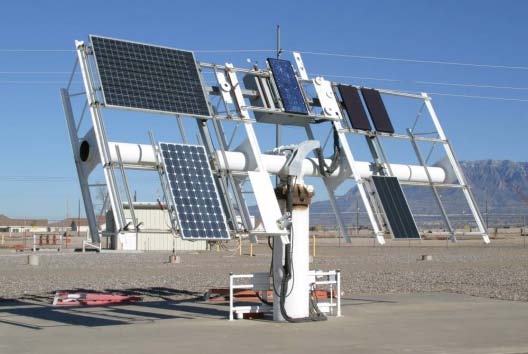
Solar cells are based on semiconductor materials. Non-conductors—into which we will carelessly toss semiconductors—have what is called a bandgap. This is the energy required to excite an electron from a bound state to a conducting state. In the bound state, electrons stay in the vicinity of the atoms to which they are attached, while in the conducting state, they are free to move. Solar cells use sunlight to excite electrons from the bound state to the conducting state, and the electrons give up that energy when they perform work for us.


Despite such vast expenditures, rust cannot be stopped, only slowed. No matter how tall our buildings, strong our bridges, or graceful our national monuments, they’re all, ultimately, headed for the trash heap. The best we can do is add another coat of paint and hope to forestall the inevitable. Rust, in other words, reveals a fundamental truth: it’s a red flaky trace of entropy. It ensures that everything that’s here today will be gone tomorrow.

Rusted Development: The Fight Against Corrosion Creep


Deflationary Collapse Ahead?


Summation

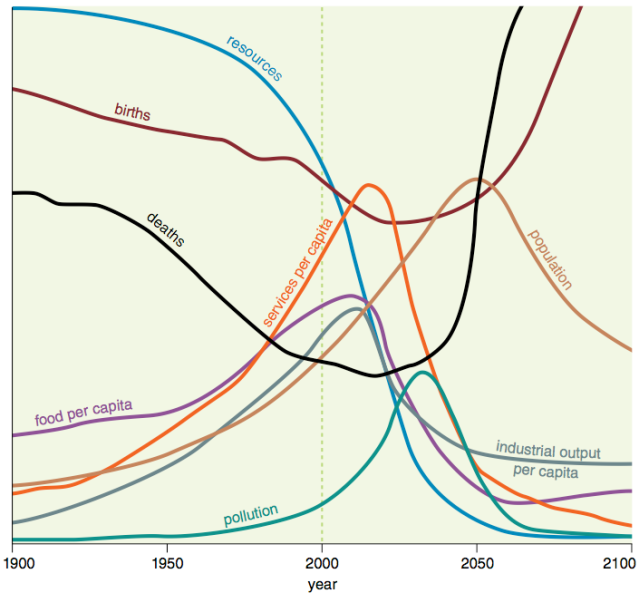
The analysis that comes closest to the situation we are reaching today is the 1972 analysis of limits of a finite world, published in the book “The Limits to Growth” by Donella Meadows and others. It models what can be expected to happen, if population and resource extraction grow as expected, gradually tapering off as diminishing returns are encountered. The base model seems to indicate that a collapse will happen about now.
Figure 5. Base scenario from 1972 Limits to Growth, printed using today's graphics by Charles Hall and John Day in "Revisiting Limits to Growth After Peak Oil" http://www.esf.edu/efb/hall/2009-05Hall0327.pdf
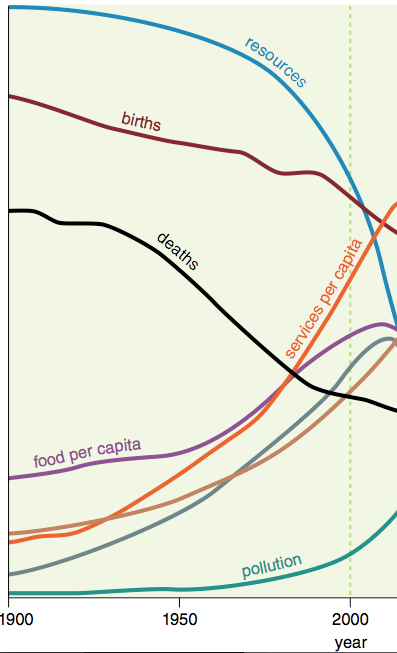
The shape of the downturn is not likely to be correct in Figure 5.  One reason is that the model was put together based on physical quantities of goods and people, without considering the role the financial system, particularly debt, plays. I expect that debt would tend to make collapse quicker. Also, the modelers had no experience with interactions in a contracting world economy, so had no idea regarding what adjustments to make. The authors have even said that the shapes of the curves, after the initial downturn, cannot be relied on. So we end up with something like Figure 6, as about all that we can rely on.
Figure 6. Figure 5, truncated shortly after production turns down, since modeled amounts are unreliable after that date.
If we are indeed facing the downturn forecast by Limits to Growth modeling, we are facing  a predicament that doesn’t have a real solution. We can make the best of what we have today, and we can try to strengthen bonds with family and friends. We can try to diversify our financial resources, so if one bank encounters problems early on, it won’t be a huge problem. We can perhaps keep a little food and water on hand, to tide us over a temporary shortage. We can study our religious beliefs for guidance.
Some people believe that it is possible for groups of survivalists to continue, given adequate preparation. This may or may not be true. The only kind of renewables that we can truly count on for the long term are those used by our forefathers, such as wood, draft animals, and wind-driven boats. Anyone who decides to use today’s technology, such as solar panels and a pump adapted for use with solar panels, needs to plan for the day when that technology fails. At that point, hard decisions will need to be made regarding how the group will live without the technology.


We can’t say that no one warned us about the predicament we are facing. Instead, we chose not to listen. Public officials gave a further push in this direction, by channeling research funds toward distant theoretically solvable problems, instead of understanding the true nature of what we are up against. Too many people took what Hubbert said literally, without understanding that what he offered was a best-case scenario, if we could find something equivalent to a perpetual motion machine to help us out of our predicament.


Learning Success: 


APPLY Tips From The Best


Image result for sir richard bransonSir Richard BransonVirgin Group – Anyone who owns more than 400 companies and is worth billions of dollars is clearly doing many things right. I admire Richard Branson’s tenacity, and I admire his personal brand

Monday, 12 August 2013

FIRST FINANCIAL INSIGHTS: #TORONTO CONDO BUBBLE CRASHING - @wallstjournal

FIRST FINANCIAL INSIGHTS: #TORONTO CONDO BUBBLE CRASHING  
TORONTO CONDO bubble CRASHING – WHAT NEXT? - READ MORE   2008 Meltdown or Japanese Bubble... (read more)

When will they ever learn? Or is it simply in the nature of our species to always create these gigantic credit-driven asset bubbles? And why is it a social phenomenon that no country, culture or region is immune to through-out history? 

From a investment view, we are seriously perturbed about Toronto's Condo Bubble and the possible outcomes that could occur when the bubble further deflates. As a result, we have placed a number of sectors on our watch list; obviously including  retail, financial, property development and construction industries. In the weeks ahead, we will provide further.comments and analysis regarding the much anticipated fall-out with more specific industry assessments.  


Remember also how globalization was sold to us as the best way to improve national economic well-being, standards of living, create jobs and lower risk levels. Now everything is so deeply inter-connected financially, physically and politically, yet these promised improvements seem to be moving us in the opposite direction. Do you think it was all a big lie serving a few special global interests? Do you think that they pulled the wool over the eyes of our political geniuses?  If you do - then you are not alone!


It begs the question - who is really governing sovereign nations given all the operative trade agreements, and organizations, such as the WTO, EU, IMF, World Bank and others, with relegated powers? Have all these supra-constitutional connections watered-down sovereign constitutions so much that national destinies have been moved beyond elected officials' powers? This may explain why Canada patterned its monetary policies after the FED - they have to!


This is a big issue that requires a good deal more analysis and thought, but there are clear hints that "globalization" was just a crafty synonym disguising "annexation". What does that have to do with the price of Condo's in Toronto?


Lots! Just ask its Mayor.   


INVESTORS' INSIGHTS

First Financial Insights

August 12, 2013


Asset Bubbles 101: 

In the end, remember nothing is...


Friday, 9 August 2013

BLOOMBERG - OOPs! - #Japan's Economy Grows Less Than Forecast

(More)


Japan’s Economy Grew Less-Than-Forecast 2.6% Last Quarter

Investment Drops - 
Annualised Growth 2.6% 

Recently folks were applauding the turn around in profits for some of JAPAN INC's biggest exporters, as short-term delusional benefits of its managed currency devaluation jumped earnings in the second quarter, leading some to even proclaim that the two decades of economic decay had finally come to an end. That celebration was short lived, as overall GDP growth for the period, did not meet expectations.

Moreover, business confidence, as measured by capital investment, drifts hesitantly despite improved profits. Consumers can look forward to a possible increase in sales taxes, that certainly cannot add to their feel good levels. Plus, as import costs increase, they can expect their pocket books to be squeezed much more in the months ahead. 

In all, the deflationary overhang is still there as low interest rates cause both consumers and businesses to act cautiously. It is still hard for commercail banks to lend too, because lenders " collateral values" can disappear in an overnight whisper of a rate increase. These internal structural weaknesses play into foreign competitions' hands as they can invest capital more effectively. That's not good for the export business.

At some point, Japan's deflation should disappear with the import of hyper-inflation on materials from other countries, at same time, so should exports. Then what?  Growing global populations and shrinking resources will not work to save this economy from the fix it entered after its financial bubble burst and the finite constraints of a shrinking planet set  in.


INVESTORS' INSIGHTS
First Financial Insights
August 9, 2013

Popular Posts All Time

Learn, win achieve